
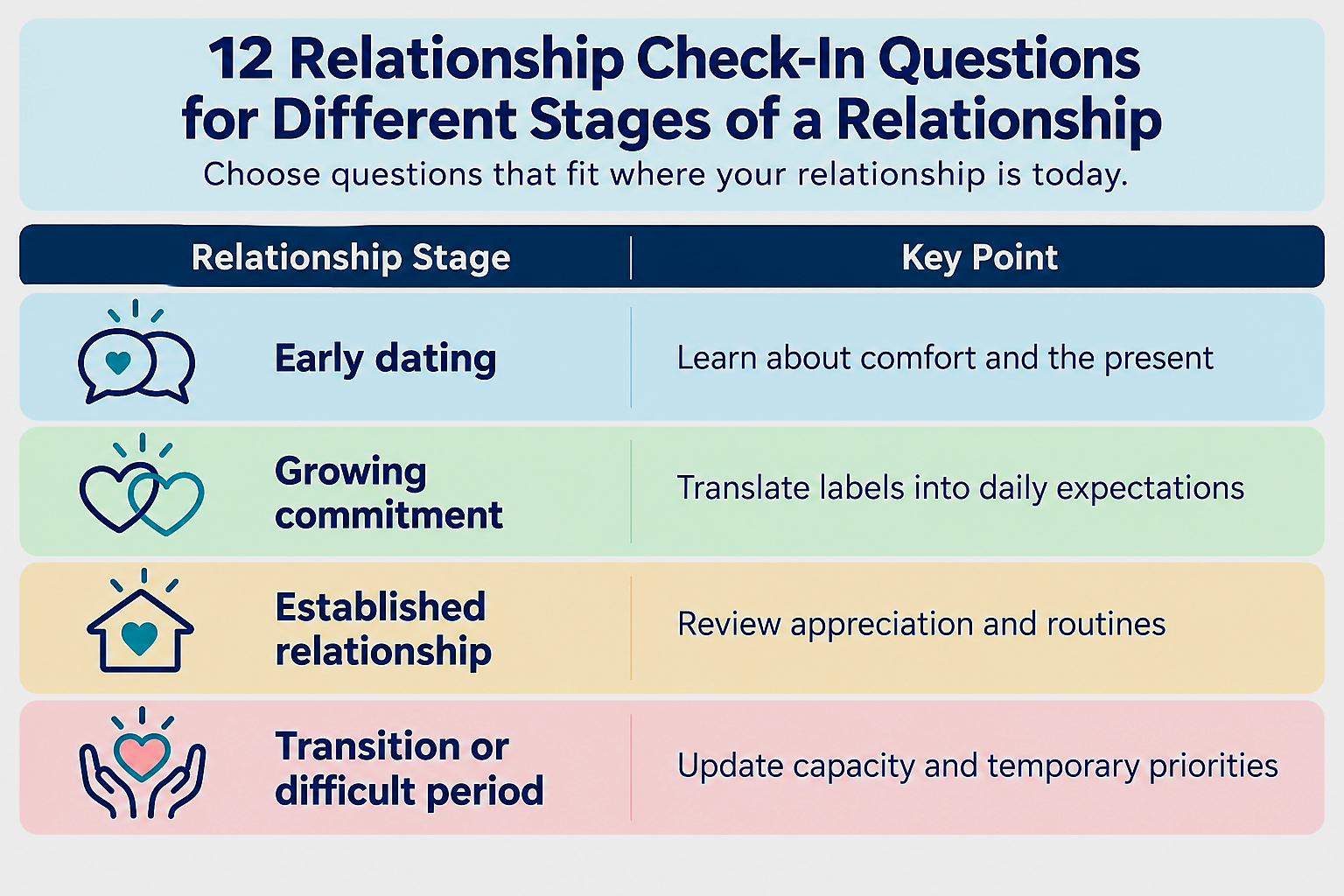
Choose relationship check-in questions according to the relationship's current stage. The question should fit what both people can answer honestly. Early dating calls for information about comfort and communication, while growing commitment requires shared meanings, and an established relationship benefits from reviewing routines. During a difficult transition, questions should update earlier assumptions about capacity. “What have you enjoyed most about seeing each other?” suits an early connection because both people can answer from the present, whereas a long-established couple may learn more by examining a habit that no longer serves either person.
How to Use a Relationship Check-In
Ask for a time that suits both people. A surprise check-in can sound like a verdict is coming, especially when one person believes the evening has another purpose. State the scope in one sentence and keep the first conversation narrow.
Work on one action at a time. State when it will be tried and when both people will review its effect. Further changes can wait for a later check-in.
Take turns answering the selected questions. The listener should first summarize the meaning they heard and invite a correction. Advice can wait until the speaker confirms that the account is accurate.
Check-in frequency should follow the rate of change in the relationship. Use one when circumstances are shifting quickly or when a previous agreement needs review, and discuss an active concern when it arises. The scheduled conversation should not become a reason to delay it.
Early Dating Check-In Questions
In early dating, ask about present comfort and preferences.
1. What Have You Enjoyed Most About Seeing Each Other?
A recent positive event gives the other person a concrete interaction to name and repeat.
Listen for the detail beneath the answer. “Dinner was good” may refer to the place, while “I liked having enough time to talk” concerns the pace of the meeting.
Share your own answer after hearing theirs. Positive disclosure becomes more informative when both people add something. One person should not remain the subject of an interview.
Repeat the type of interaction both people enjoyed, or ask one connected question about what made it satisfying.
2. Is Anything About Our Pace Making You Uncomfortable?
Pace can include message frequency and time together. It may also cover physical affection or the depth of personal subjects.
Ask in a neutral tone and leave your preferred answer unstated.
A pause before the answer may mean the person is choosing careful words. If the answer identifies a limit, ask what change would make the next interaction more comfortable.
Do not pressure the person to withdraw or revise a boundary.
3. What Helps You Feel Listened to When We Talk?
People differ in what they recognize as attention. One person may want a follow-up question, while another may prefer time to finish a thought before the listener responds. A recent example names a behavior both people can repeat. Tell your partner which response helps you. Their preference may call for a different response.
Try the named listening behavior in the next meaningful conversation, then ask if it helped.
Growing Commitment Check-In Questions
As commitment grows, familiar labels can conceal different expectations. This stage benefits from questions that connect a shared word to conduct each person can recognize.
4. What Does Commitment Mean in Practice to You?
Ask what commitment changes in ordinary life. Useful answers may concern how plans are made or how conflicts are revisited. Communication during a difficult week may also reveal what the label means. Ask for the present behavior that gives commitment meaning because a distant declaration leaves current behavior undefined. After both people have spoken, compare their descriptions for agreements that can become explicit practices. Discuss each unresolved expectation in its own conversation.
Record only the agreement that requires follow-through. Long notes can make a relationship conversation resemble an evaluation form.
5. What Kind of Support Is Useful When You Are Stressed?
Ask if support means company or space, then clarify if the person wants listening or practical help. Ask what response makes the stress harder to manage. Clarifying the desired response prevents unsolicited advice when the person wants acknowledgment. Use a recent stress example to agree on a response for the next difficult moment.
6. Which Parts of Your Independent Life Need More Room?
Independent friendships and interests need protected time as the relationship grows. Ask where shared plans have started to crowd out an important independent commitment. Set disputed calendar choices aside for a later conversation. Protect the named commitment on the calendar and check how the change affects shared time.
Established Relationship Check-In Questions

An established relationship has more history to draw from and more habits that can continue without deliberate review. Start with a routine created for earlier work hours or responsibilities.
7. What Has Made You Feel Appreciated Lately?
Ask for a recent action. A recent conversation or task gives both people a behavior they can repeat. Find out what the action communicated. The practical help may have mattered because it reduced pressure. A short message may have shown that the person was remembered during a busy day.
Name one action from the other person that you also appreciated. The exchange should document useful behavior on both sides.
When an appreciated behavior is already happening, repeat it when the relevant situation returns.
8. Which Shared Routine No Longer Fits?
A routine may have been sensible when work hours or responsibilities were different. Ask which shared habit now creates friction or wastes limited energy. It may also prevent either person from getting what the routine was meant to provide. Change one part first. Replacing an entire weekly structure at once makes it difficult to learn which adjustment solved the problem.
9. What Would You Like to Try Together Next?
Suggest a different walk or a class that is new to both people. Another option could be to change how the two people spend one evening.
Discuss the practical limit before choosing. Time and energy affect which idea is realistic, and selecting an activity beyond current capacity can create another obligation. Choose the option that attracts genuine interest from both people. Schedule it if the activity requires advance planning. Leave it informal for now if making plans would add pressure.
Transition and Difficult-Period Check-In Questions
A sharp change in health or workload can make old agreements impossible. Name the capacity change before reviewing a missed routine.
10. What Has Changed in Your Current Capacity?
Capacity includes attention and physical energy. It also includes how much uncertainty a person can manage while other parts of life are unstable. Ask for the area with the largest change.
A broad answer about being overwhelmed may become more useful when connected to evenings or social plans. Difficult conversations may require a separate account of current capacity.
State the assumption each person brought into the conflict so the source of the mismatch is explicit. Use the answer to revise one current demand. A temporary reduction is easier to evaluate when the two people know which obligation changed.
11. Which Expectation Needs to Be Updated?
Changed capacity often exposes an agreement that belonged to an earlier period. Name one expectation about availability or shared tasks that neither person can meet in its current form. Communication expectations deserve their own wording when they are the source of the mismatch. Replace the outdated agreement with a temporary version and state when it will be reviewed. An open-ended reduction can produce uncertainty after the difficult period begins to ease.
12. What Can We Postpone While This Period Is Demanding?
Some decisions can wait without harming the relationship. Identify an optional project or recurring obligation that consumes attention needed for immediate health and connection. Postponement should have a review point. Set a date or name the concrete change in circumstances that will bring the subject back for discussion.
During the pause, note active health tasks and commitments to other people. Inform each other if the deferred item begins to create new strain in current circumstances. Bring the review forward when circumstances change faster than expected.
Turn the Answer Into a Next Step
End the check-in by stating one thing each person learned. The summary should describe the other person's meaning closely enough that they can correct it.
Repeat appreciated behavior informally. For a routine conflict, try a small experiment and set a review point.
A subject that needs more time should receive a separate conversation. Finishing the current check-in preserves the attention required for the next one and keeps a large disagreement from absorbing every question.
Schedule the next check-in according to the rate of change. A new relationship or active transition may need an earlier review. An established relationship with stable agreements can wait longer, while any urgent concern should be discussed as soon as both people can do so safely.
